

BLOG
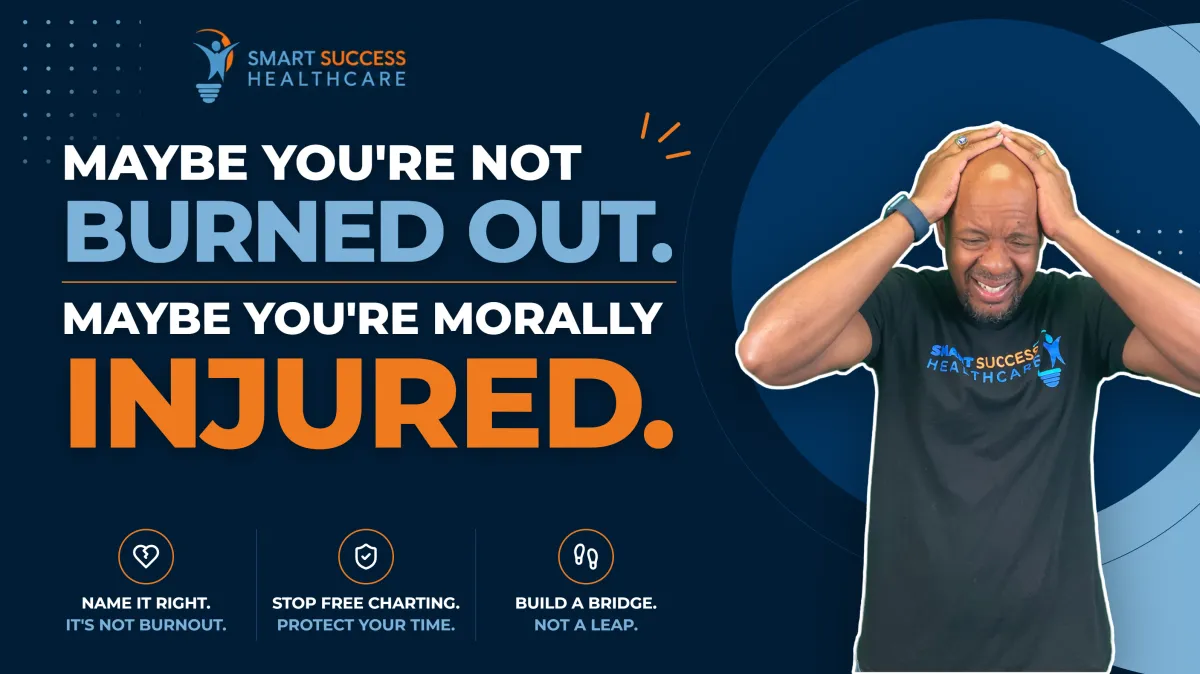
Maybe You’re Not Burned Out. Maybe You’re Morally Injured.
Maybe You’re Not Burned Out. Maybe You’re Morally Injured.
I want to talk to the healthcare professional who has sat in their car in the parking lot before a shift trying to convince themselves to walk through the door.
I know that feeling because I've been there.
You're sitting there thinking, “Gosh, man. I can't do this anymore.” But then you start questioning yourself. Maybe I'm just tired. Maybe I need a vacation. Maybe I need to suck it up. Maybe everybody feels this way.
And we've been taught to call all of that burnout.
But I want to give you another way to look at it.
Maybe you're not just burned out. Maybe you're dealing with moral injury.
Burnout and Moral Injury Aren't the Same Thing
Burnout can happen when the workload becomes too much. You're exhausted. You're overwhelmed. You don't have enough time to recover.
Moral injury is different.
Moral injury happens when you're repeatedly put in situations where what you're being asked to do conflicts with what you believe is right.
You know a patient needs more time, but productivity says you have to move on. You know someone could benefit from more care, but insurance says their visits are done. You stay after work finishing documentation because you actually care about doing things correctly, but nobody is paying you for that time.
You were trained to practice physical therapy, occupational therapy, speech therapy, dietetics, or whatever your profession is.
Then you get into the real world and realize that sometimes you're practicing insurance therapy.
That's a very different thing.
And after enough years of that, something starts happening to you.
The People Who Care the Most Can Get Hit the Hardest
I remember when I was in PT school. There were basically two types of people.
There were people who genuinely loved this stuff. They drank the PT Kool-Aid. They wanted to help people. They wanted to become great clinicians. They cared about getting people better.
Then there were other people who basically looked at physical therapy and said, “Seems like a pretty good job. Decent money. Decent hours. I'll do this.”
And I'm not even saying there's anything wrong with that.
But here's what I noticed.
When things started getting difficult in the profession, the second group could leave pretty easily. I saw people go into construction. Some went back to school. Some became PAs or physicians. They realized PT wasn't what they thought it was going to be and said, “Yo, I'm out.”
But the people who REALLY cared?
Those are often the people who stayed and kept giving more.
That's where the system can get you.
Because if you care deeply about your patients, you'll cover the gap.
You'll stay late.
You'll finish that chart at home.
You'll answer the extra question.
You'll squeeze somebody into your schedule.
You'll give more than you're being compensated for because your conscience won't let you give the patient less.
Your caring becomes unpaid labor.
And eventually, you start paying the price for it.
This Is Why You Start Resenting Something You Used to Love
I don't think most healthcare professionals wake up one morning and suddenly hate their profession.
It happens slowly.
You give a little extra here. Stay 30 minutes late there. Take documentation home. Skip lunch because you're behind. See another patient because somebody needs help.
You keep telling yourself, “This is just part of being a good healthcare professional.”
Then five or ten years go by and you're exhausted.
Now you're irritated with patients.
You're irritated with your employer.
You're irritated with insurance companies.
Maybe you're even irritated with the profession you once loved.
That's when a lot of people think they only have two options.
Option one: Stay exactly where you are and accept it.
Option two: Quit tomorrow, start a business, and hope everything works out.
I don't like either of those options.
There's another way.
You Don't Need to Jump Off the Fourth Floor
My podcast studio is in my townhouse, and my townhouse has four floors.
Imagine you're standing on the fourth floor and you tell me you need to get down to the first floor.
Would I tell you to jump?
Of course not.
I wouldn't tell you to jump from the third floor either. I wouldn't even tell you to jump from the second floor.
I'd tell you to take the stairs.
One step.
Then another.
Then another.
It might take a little longer, but eventually you're standing safely on the first floor.
That's how I want healthcare professionals to think about getting out of situations that are hurting them.
You don't need a leap. You need a bridge.
You don't have to walk into your job tomorrow and say, “I quit.”
You can build your way out.
Start With Two
Let's say you're making $70,000 a year.
That's roughly $1,350 a week.
Now let's say you have a skill people are willing to pay you $150 per session for outside of your job.
It takes nine sessions at $150 to generate about $1,350.
Nine.
When people hear that, they immediately start thinking, “Greg, how the heck am I supposed to get nine clients?”
You're not.
Not yet.
Your first goal is two.
Maybe you see two people on Saturday.
That's it.
Then eventually two becomes four. Four becomes six. And as you get better and people start getting results, something else happens: they tell other people.
Now six can become nine.
Maybe that takes three months. Maybe it takes four. Maybe it takes longer.
Who cares?
You're building the stairs.
And every step gives you a little more control over your life.
Protect Yourself While You Build
Here's the other part of this that I think is incredibly important.
While you're building, stop donating yourself to your job.
Work your hours.
Do your job well.
Take care of your patients.
But when your workday is over, go home.
Stop making free charting a normal part of your life. Stop believing you have to sacrifice every evening to prove that you're a caring healthcare professional.
Take some of that energy and build something for yourself.
Then, when YOU control the business and you want to give somebody extra time, great. Give them extra time.
But build that time into your price.
Now you can spend an extra 20 minutes with somebody because you believe they need it without sitting there thinking, “I'm working for free again.”
That's a completely different feeling.
You're serving because you chose to, not because a system forced you to.
The Goal Isn't Necessarily to Leave Healthcare
I think this is where people misunderstand the conversation.
The goal isn't to convince every PT, OT, SLP, dietitian, chiropractor, or other healthcare professional to quit.
The goal is to put you back in a position where you have choices.
Because when you don't have choices, everything feels heavier.
You tolerate things you shouldn't tolerate because you need the paycheck. You give away your time because you're afraid of what happens if you don't. You continue operating against your own standards because you don't see another option.
Building something on the side changes that.
Maybe eventually you leave your job.
Maybe you cut down to three days a week.
Maybe you stay employed but now have an additional income stream that gives your family breathing room.
The point is that you get some control back.
And when you have control, you can start practicing according to your standards again.
Take One Step
If you're sitting in your car before work trying to convince yourself to walk through the door, I don't want you thinking you have to figure out your entire life today.
You don't.
And I don't want you believing your only options are to keep suffering or blow everything up tomorrow.
There are stairs.
Take one step.
Maybe your first step is deciding you're no longer going to chart for free every night. Maybe it's figuring out what problem you're really good at solving. Maybe it's finding the first person willing to pay you $150 to help them solve it.
Then find the second.
Then the third.
Keep building.
Because the answer isn't always to stop caring.
Sometimes the answer is to build a life and a business where caring about people no longer requires you to sacrifice yourself in the process.
Much Love,
Greg
Follow Greg on Socials:
https://www.Instagram.com/gregtoddpt
https://www.Facebook.com/gregtoddpt

Maybe You’re Not Burned Out. Maybe You’re Morally Injured.
Maybe You’re Not Burned Out. Maybe You’re Morally Injured.
I want to talk to the healthcare professional who has sat in their car in the parking lot before a shift trying to convince themselves to walk through the door.
I know that feeling because I've been there.
You're sitting there thinking, “Gosh, man. I can't do this anymore.” But then you start questioning yourself. Maybe I'm just tired. Maybe I need a vacation. Maybe I need to suck it up. Maybe everybody feels this way.
And we've been taught to call all of that burnout.
But I want to give you another way to look at it.
Maybe you're not just burned out. Maybe you're dealing with moral injury.
Burnout and Moral Injury Aren't the Same Thing
Burnout can happen when the workload becomes too much. You're exhausted. You're overwhelmed. You don't have enough time to recover.
Moral injury is different.
Moral injury happens when you're repeatedly put in situations where what you're being asked to do conflicts with what you believe is right.
You know a patient needs more time, but productivity says you have to move on. You know someone could benefit from more care, but insurance says their visits are done. You stay after work finishing documentation because you actually care about doing things correctly, but nobody is paying you for that time.
You were trained to practice physical therapy, occupational therapy, speech therapy, dietetics, or whatever your profession is.
Then you get into the real world and realize that sometimes you're practicing insurance therapy.
That's a very different thing.
And after enough years of that, something starts happening to you.
The People Who Care the Most Can Get Hit the Hardest
I remember when I was in PT school. There were basically two types of people.
There were people who genuinely loved this stuff. They drank the PT Kool-Aid. They wanted to help people. They wanted to become great clinicians. They cared about getting people better.
Then there were other people who basically looked at physical therapy and said, “Seems like a pretty good job. Decent money. Decent hours. I'll do this.”
And I'm not even saying there's anything wrong with that.
But here's what I noticed.
When things started getting difficult in the profession, the second group could leave pretty easily. I saw people go into construction. Some went back to school. Some became PAs or physicians. They realized PT wasn't what they thought it was going to be and said, “Yo, I'm out.”
But the people who REALLY cared?
Those are often the people who stayed and kept giving more.
That's where the system can get you.
Because if you care deeply about your patients, you'll cover the gap.
You'll stay late.
You'll finish that chart at home.
You'll answer the extra question.
You'll squeeze somebody into your schedule.
You'll give more than you're being compensated for because your conscience won't let you give the patient less.
Your caring becomes unpaid labor.
And eventually, you start paying the price for it.
This Is Why You Start Resenting Something You Used to Love
I don't think most healthcare professionals wake up one morning and suddenly hate their profession.
It happens slowly.
You give a little extra here. Stay 30 minutes late there. Take documentation home. Skip lunch because you're behind. See another patient because somebody needs help.
You keep telling yourself, “This is just part of being a good healthcare professional.”
Then five or ten years go by and you're exhausted.
Now you're irritated with patients.
You're irritated with your employer.
You're irritated with insurance companies.
Maybe you're even irritated with the profession you once loved.
That's when a lot of people think they only have two options.
Option one: Stay exactly where you are and accept it.
Option two: Quit tomorrow, start a business, and hope everything works out.
I don't like either of those options.
There's another way.
You Don't Need to Jump Off the Fourth Floor
My podcast studio is in my townhouse, and my townhouse has four floors.
Imagine you're standing on the fourth floor and you tell me you need to get down to the first floor.
Would I tell you to jump?
Of course not.
I wouldn't tell you to jump from the third floor either. I wouldn't even tell you to jump from the second floor.
I'd tell you to take the stairs.
One step.
Then another.
Then another.
It might take a little longer, but eventually you're standing safely on the first floor.
That's how I want healthcare professionals to think about getting out of situations that are hurting them.
You don't need a leap. You need a bridge.
You don't have to walk into your job tomorrow and say, “I quit.”
You can build your way out.
Start With Two
Let's say you're making $70,000 a year.
That's roughly $1,350 a week.
Now let's say you have a skill people are willing to pay you $150 per session for outside of your job.
It takes nine sessions at $150 to generate about $1,350.
Nine.
When people hear that, they immediately start thinking, “Greg, how the heck am I supposed to get nine clients?”
You're not.
Not yet.
Your first goal is two.
Maybe you see two people on Saturday.
That's it.
Then eventually two becomes four. Four becomes six. And as you get better and people start getting results, something else happens: they tell other people.
Now six can become nine.
Maybe that takes three months. Maybe it takes four. Maybe it takes longer.
Who cares?
You're building the stairs.
And every step gives you a little more control over your life.
Protect Yourself While You Build
Here's the other part of this that I think is incredibly important.
While you're building, stop donating yourself to your job.
Work your hours.
Do your job well.
Take care of your patients.
But when your workday is over, go home.
Stop making free charting a normal part of your life. Stop believing you have to sacrifice every evening to prove that you're a caring healthcare professional.
Take some of that energy and build something for yourself.
Then, when YOU control the business and you want to give somebody extra time, great. Give them extra time.
But build that time into your price.
Now you can spend an extra 20 minutes with somebody because you believe they need it without sitting there thinking, “I'm working for free again.”
That's a completely different feeling.
You're serving because you chose to, not because a system forced you to.
The Goal Isn't Necessarily to Leave Healthcare
I think this is where people misunderstand the conversation.
The goal isn't to convince every PT, OT, SLP, dietitian, chiropractor, or other healthcare professional to quit.
The goal is to put you back in a position where you have choices.
Because when you don't have choices, everything feels heavier.
You tolerate things you shouldn't tolerate because you need the paycheck. You give away your time because you're afraid of what happens if you don't. You continue operating against your own standards because you don't see another option.
Building something on the side changes that.
Maybe eventually you leave your job.
Maybe you cut down to three days a week.
Maybe you stay employed but now have an additional income stream that gives your family breathing room.
The point is that you get some control back.
And when you have control, you can start practicing according to your standards again.
Take One Step
If you're sitting in your car before work trying to convince yourself to walk through the door, I don't want you thinking you have to figure out your entire life today.
You don't.
And I don't want you believing your only options are to keep suffering or blow everything up tomorrow.
There are stairs.
Take one step.
Maybe your first step is deciding you're no longer going to chart for free every night. Maybe it's figuring out what problem you're really good at solving. Maybe it's finding the first person willing to pay you $150 to help them solve it.
Then find the second.
Then the third.
Keep building.
Because the answer isn't always to stop caring.
Sometimes the answer is to build a life and a business where caring about people no longer requires you to sacrifice yourself in the process.
Much Love,
Greg
Follow Greg on Socials:
https://www.Instagram.com/gregtoddpt
https://www.Facebook.com/gregtoddpt
Join us on our Social Media
platforms to learn and grow with Smart Success Healthcare
We help Physical Therapists, Occupational Therapists, Dietitians and Chiropractors achieve multi 6 to 7 figures per month with few staff, happy patients and great results!

Join us on our Social Media platforms to learn and grow with
Smart Success Healthcare
We help Physical Therapists, Occupational Therapists, Dietitians and Chiropractors achieve
multi 6 to 7 figures per month with few staff, happy patients and great results!
Youtube

Greg Todd helps healthcare professionals make a massive impact and income. Learn how to start & scale a business that brings you time, clinical and financial freedom.

Follow Greg's stories to learn more about what happens in the SSHC world.


Podcast

Watch Greg's podcast
"Wealth Code Secrets" and learn how to grow and scale your business.