BLOG
The 128-Hour Opportunity Most Healthcare Professionals Are Missing
The 128-Hour Opportunity Most Healthcare Professionals Are Missing
One of the most powerful things a mentor ever told me came from Myron Golden.
He said, “Greg, what you lack in ability, you make up for in leverage.”
That hit me hard because I think nearly every healthcare professional struggles with feeling like they're not enough at some point in their career. When you're young, you think, “I don't have enough experience yet. Who am I to teach somebody this?” Then you get older and suddenly the story changes to, “Maybe I'm too old. I'm behind. I don't understand all this new technology.”
It's like we have this Benjamin Button complex where we're either too young or too old, but somehow we're never the perfect age to believe we're capable enough.
And by the way, I struggle with this too. There are still things I look at and think, “Man, I don't know enough about that.” There are still moments where my confidence gets rocked.
But what Myron helped me understand is that maybe the answer isn't becoming the smartest, most talented, most experienced person in the room.
Maybe the answer is leverage.
There Are 168 Hours in Every Week
Let's do some simple math. There are 24 hours in a day and seven days in a week. That's 168 hours.
Most of us have been trained to earn money inside roughly 40 of those hours. Maybe you work 30. Maybe you work 50. But for most healthcare professionals, the basic vehicle we've been given is the same: you work, you get paid.
If you want to provide more value, you have to work more. If you want to make more money, you have to see another patient. Pick up another shift. Add another day. Work another weekend.
That's the model.
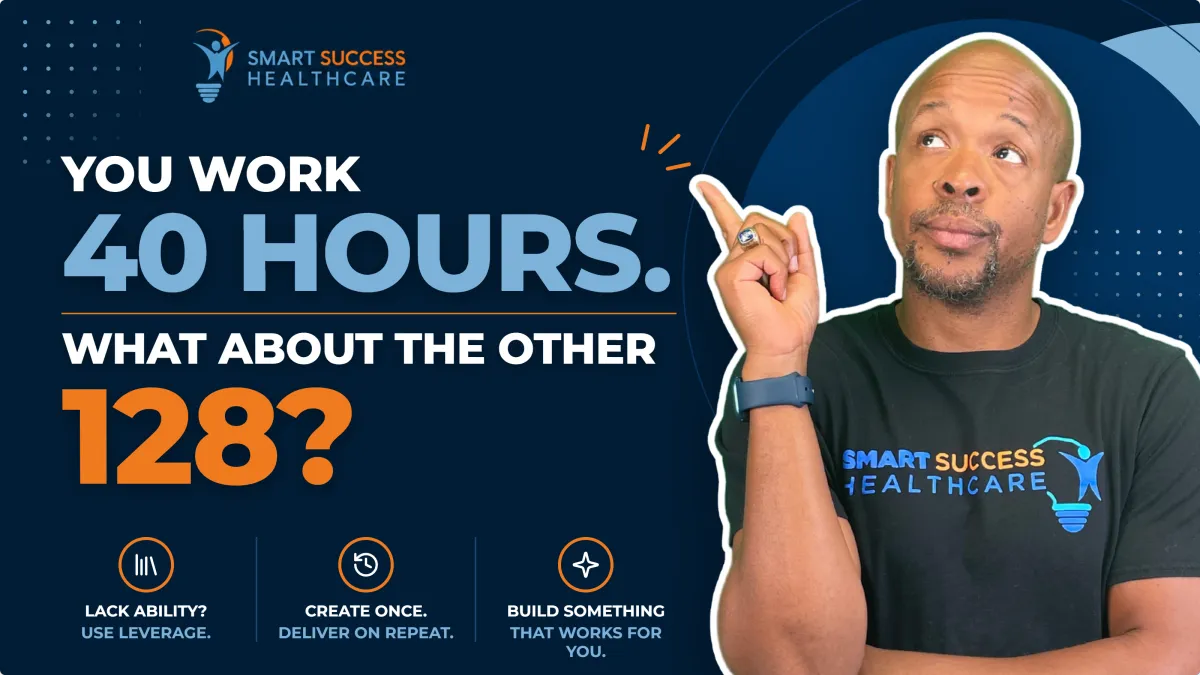
But if you work 40 hours out of 168, there are another 128 hours every single week.
Now, I already know what some of you are thinking.
“Greg, I'm supposed to SLEEP during some of those hours.”
Yes.
“And I have a family.”
I know.
“I need to rest. Exercise. Eat. Have a life.”
You're absolutely right.
I'm not suggesting you work another 128 hours. I'm asking you a completely different question:
What could you create that continues bringing value to people during those 128 hours without requiring you to physically be there?
That's the opportunity.
Healthcare Professionals Have Been Trained to Think About Value the Wrong Way
One of the biggest things I've come to understand about business is that business is really about bringing value to the marketplace.
The problem for most healthcare professionals isn't that they don't have value. You have a TON of value.
You spent years learning things the average person doesn't know. You understand the human body. You understand movement, nutrition, communication, rehabilitation, pain, recovery, behavior change, or whatever your particular area of expertise happens to be.
But most of us were taught only one way to distribute that value.
One person at a time.
For one hour.
In one physical location.
Think about that.
You could be an absolutely amazing physical therapist, occupational therapist, speech therapist, dietitian, chiropractor, or other healthcare professional. But if the only way someone can receive value from you is by sitting directly in front of you, there's a ceiling on how many people you can help.
That's not necessarily an ability problem.
That's a leverage problem.
My Content Works When I'm Not Working
I'll give you an example from my own life.
At the time I recorded the podcast episode that inspired this article, my Instagram and Facebook content was getting hundreds of thousands of views. Thousands of people could consume something I created on any given day.
Now here's what's interesting.
I didn't have to personally sit in front of every one of those people.
I could record something once and go to my son's practice. While I'm sitting at his practice, somebody could be watching that video.
I could go to sleep. Somebody could still watch it.
I could spend time with my family. Somebody could still watch it.
And that person might be learning something from me for the very first time.
In fact, I once had the founder of 1-800-Flowers.com reach out to me because he had been consuming my content and wanted me to come on his podcast.
Think about that.
I didn't cold call him.
I didn't hunt him down and say, “Hey, let me tell you how awesome I am.”
I created something valuable, put it into the world, and that value continued working after I was finished creating it.
That's leverage.
Content Isn't the Only Way to Do This
This is where I think healthcare professionals need to expand their thinking.
Content is one form of leverage, but it's not the only one. You could create a digital product that solves a specific problem for someone. You build it once, and somebody can purchase and use it tonight while you're eating dinner.
You could create a membership where people receive education, guidance, accountability, tools, and community month after month. Not every piece of that experience requires you to personally be there every second.
You could create an app that helps people track something important, follow an exercise program, manage a particular problem, or improve some area of their health.
You could even change the way you package a service you already provide. Instead of believing you can only be compensated for individual units of your time, you can build a solutions-based offer around helping somebody achieve a specific result.
There are lots of different models.
The model isn't really the point.
The point is separating your ability to create value from your requirement to physically be there every single time that value is delivered.
Stop Asking, “Am I Good Enough?”
I think this is especially important for the healthcare professional who keeps waiting.
You're waiting until you know more.
Waiting until you have another certification.
Waiting until you've been practicing five more years.
Waiting until you understand social media.
Waiting until you feel confident.
Here's the bad news: there's a pretty good chance that day never comes.
Because I've worked with healthcare professionals ranging from brand-new grads to people who've been practicing for 40-plus years, and I've watched both groups question themselves.
The new grad says, “I'm too young.”
The experienced clinician says, “I'm too old.”
The new grad says, “I don't have enough experience.”
The experienced clinician says, “I'm outdated.”
So when exactly are you allowed to believe you have something valuable to offer?
That's why Myron's statement was so powerful for me.
What you lack in ability, you make up for in leverage.
I'm not saying you shouldn't continue learning. Of course you should. I'm not saying expertise doesn't matter. It absolutely does.
I'm saying you don't have to wait until you know everything before you figure out how to take what you DO know and bring it to more people.
The Goal Isn't to Work 168 Hours
I want to make this crystal clear because I don't want somebody finishing this article thinking Greg just told them to work every waking hour of their life.
That's the exact opposite of what I'm saying.
I don't want you working all 168 hours.
I want you thinking about how something you created during one of those hours can continue working during the others.
That's a completely different game.
If I spend an hour treating someone, that hour is over when the session ends.
If I spend an hour creating something valuable, that thing could potentially help people tomorrow, next week, next month, or even years from now.
Now we're talking about leverage.
And when you start understanding leverage, you stop seeing your 40-hour workweek as the only place where your value exists.
What's Working During Your Other 128?
That's the question I want you thinking about this week.
Not, “How can I work more?”
Not, “How can I squeeze another ten patients into my schedule?”
Not even, “How can I make more money?”
Ask yourself:
What could I create once that continues bringing value to people when I'm no longer there?
Maybe it's content.
Maybe it's a digital product.
Maybe it's a membership.
Maybe it's an app.
Maybe it's a solutions-based offer built around your expertise.
Your answer doesn't have to be my answer. But if your income and impact can only happen while you're physically working, you're leaving an enormous amount of leverage on the table.
There are 168 hours this week.
You might work 40 of them.
Sleep. Spend time with your family. Go to your kid's practice. Exercise. Take care of yourself. Enjoy your life.
But start thinking differently about the other 128.
You don't have to work during those hours. Build something that can.
Much Love,
Greg Todd
Follow Greg on Socials:
https://www.Instagram.com/gregtoddpt
https://www.Facebook.com/gregtoddpt

The 128-Hour Opportunity Most Healthcare Professionals Are Missing
The 128-Hour Opportunity Most Healthcare Professionals Are Missing
One of the most powerful things a mentor ever told me came from Myron Golden.
He said, “Greg, what you lack in ability, you make up for in leverage.”
That hit me hard because I think nearly every healthcare professional struggles with feeling like they're not enough at some point in their career. When you're young, you think, “I don't have enough experience yet. Who am I to teach somebody this?” Then you get older and suddenly the story changes to, “Maybe I'm too old. I'm behind. I don't understand all this new technology.”
It's like we have this Benjamin Button complex where we're either too young or too old, but somehow we're never the perfect age to believe we're capable enough.
And by the way, I struggle with this too. There are still things I look at and think, “Man, I don't know enough about that.” There are still moments where my confidence gets rocked.
But what Myron helped me understand is that maybe the answer isn't becoming the smartest, most talented, most experienced person in the room.
Maybe the answer is leverage.
There Are 168 Hours in Every Week
Let's do some simple math. There are 24 hours in a day and seven days in a week. That's 168 hours.
Most of us have been trained to earn money inside roughly 40 of those hours. Maybe you work 30. Maybe you work 50. But for most healthcare professionals, the basic vehicle we've been given is the same: you work, you get paid.
If you want to provide more value, you have to work more. If you want to make more money, you have to see another patient. Pick up another shift. Add another day. Work another weekend.
That's the model.
But if you work 40 hours out of 168, there are another 128 hours every single week.
Now, I already know what some of you are thinking.
“Greg, I'm supposed to SLEEP during some of those hours.”
Yes.
“And I have a family.”
I know.
“I need to rest. Exercise. Eat. Have a life.”
You're absolutely right.
I'm not suggesting you work another 128 hours. I'm asking you a completely different question:
What could you create that continues bringing value to people during those 128 hours without requiring you to physically be there?
That's the opportunity.
Healthcare Professionals Have Been Trained to Think About Value the Wrong Way
One of the biggest things I've come to understand about business is that business is really about bringing value to the marketplace.
The problem for most healthcare professionals isn't that they don't have value. You have a TON of value.
You spent years learning things the average person doesn't know. You understand the human body. You understand movement, nutrition, communication, rehabilitation, pain, recovery, behavior change, or whatever your particular area of expertise happens to be.
But most of us were taught only one way to distribute that value.
One person at a time.
For one hour.
In one physical location.
Think about that.
You could be an absolutely amazing physical therapist, occupational therapist, speech therapist, dietitian, chiropractor, or other healthcare professional. But if the only way someone can receive value from you is by sitting directly in front of you, there's a ceiling on how many people you can help.
That's not necessarily an ability problem.
That's a leverage problem.
My Content Works When I'm Not Working
I'll give you an example from my own life.
At the time I recorded the podcast episode that inspired this article, my Instagram and Facebook content was getting hundreds of thousands of views. Thousands of people could consume something I created on any given day.
Now here's what's interesting.
I didn't have to personally sit in front of every one of those people.
I could record something once and go to my son's practice. While I'm sitting at his practice, somebody could be watching that video.
I could go to sleep. Somebody could still watch it.
I could spend time with my family. Somebody could still watch it.
And that person might be learning something from me for the very first time.
In fact, I once had the founder of 1-800-Flowers.com reach out to me because he had been consuming my content and wanted me to come on his podcast.
Think about that.
I didn't cold call him.
I didn't hunt him down and say, “Hey, let me tell you how awesome I am.”
I created something valuable, put it into the world, and that value continued working after I was finished creating it.
That's leverage.
Content Isn't the Only Way to Do This
This is where I think healthcare professionals need to expand their thinking.
Content is one form of leverage, but it's not the only one. You could create a digital product that solves a specific problem for someone. You build it once, and somebody can purchase and use it tonight while you're eating dinner.
You could create a membership where people receive education, guidance, accountability, tools, and community month after month. Not every piece of that experience requires you to personally be there every second.
You could create an app that helps people track something important, follow an exercise program, manage a particular problem, or improve some area of their health.
You could even change the way you package a service you already provide. Instead of believing you can only be compensated for individual units of your time, you can build a solutions-based offer around helping somebody achieve a specific result.
There are lots of different models.
The model isn't really the point.
The point is separating your ability to create value from your requirement to physically be there every single time that value is delivered.
Stop Asking, “Am I Good Enough?”
I think this is especially important for the healthcare professional who keeps waiting.
You're waiting until you know more.
Waiting until you have another certification.
Waiting until you've been practicing five more years.
Waiting until you understand social media.
Waiting until you feel confident.
Here's the bad news: there's a pretty good chance that day never comes.
Because I've worked with healthcare professionals ranging from brand-new grads to people who've been practicing for 40-plus years, and I've watched both groups question themselves.
The new grad says, “I'm too young.”
The experienced clinician says, “I'm too old.”
The new grad says, “I don't have enough experience.”
The experienced clinician says, “I'm outdated.”
So when exactly are you allowed to believe you have something valuable to offer?
That's why Myron's statement was so powerful for me.
What you lack in ability, you make up for in leverage.
I'm not saying you shouldn't continue learning. Of course you should. I'm not saying expertise doesn't matter. It absolutely does.
I'm saying you don't have to wait until you know everything before you figure out how to take what you DO know and bring it to more people.
The Goal Isn't to Work 168 Hours
I want to make this crystal clear because I don't want somebody finishing this article thinking Greg just told them to work every waking hour of their life.
That's the exact opposite of what I'm saying.
I don't want you working all 168 hours.
I want you thinking about how something you created during one of those hours can continue working during the others.
That's a completely different game.
If I spend an hour treating someone, that hour is over when the session ends.
If I spend an hour creating something valuable, that thing could potentially help people tomorrow, next week, next month, or even years from now.
Now we're talking about leverage.
And when you start understanding leverage, you stop seeing your 40-hour workweek as the only place where your value exists.
What's Working During Your Other 128?
That's the question I want you thinking about this week.
Not, “How can I work more?”
Not, “How can I squeeze another ten patients into my schedule?”
Not even, “How can I make more money?”
Ask yourself:
What could I create once that continues bringing value to people when I'm no longer there?
Maybe it's content.
Maybe it's a digital product.
Maybe it's a membership.
Maybe it's an app.
Maybe it's a solutions-based offer built around your expertise.
Your answer doesn't have to be my answer. But if your income and impact can only happen while you're physically working, you're leaving an enormous amount of leverage on the table.
There are 168 hours this week.
You might work 40 of them.
Sleep. Spend time with your family. Go to your kid's practice. Exercise. Take care of yourself. Enjoy your life.
But start thinking differently about the other 128.
You don't have to work during those hours. Build something that can.
Much Love,
Greg Todd
Follow Greg on Socials:
https://www.Instagram.com/gregtoddpt
https://www.Facebook.com/gregtoddpt
Join us on our Social Media
platforms to learn and grow with Smart Success Healthcare
We help Physical Therapists, Occupational Therapists, Dietitians and Chiropractors achieve multi 6 to 7 figures per month with few staff, happy patients and great results!

Join us on our Social Media platforms to learn and grow with
Smart Success Healthcare
We help Physical Therapists, Occupational Therapists, Dietitians and Chiropractors achieve
multi 6 to 7 figures per month with few staff, happy patients and great results!
Youtube

Greg Todd helps healthcare professionals make a massive impact and income. Learn how to start & scale a business that brings you time, clinical and financial freedom.

Follow Greg's stories to learn more about what happens in the SSHC world.


Podcast

Watch Greg's podcast
"Wealth Code Secrets" and learn how to grow and scale your business.